

Addressing disparities for intersectional BIPOC communities: the hood medicine initiative case study
Emily Hotez, PhDa,y,*, Shanice Hudson, PhDb,y, Anchuen Cho, PhDa,b, Charles Senteio, PhDb,c,Jonathan Whiteb, Doug Slaughter, MPHb, Peter Hotez, MD, PhDd, Quinn Chipley, MD, PhDb
a David Geffen School of Medicine, University of California, Los Angeles (UCLA), 911 Broxton Ave, Los Angeles, CA, 90024
b Hood Medicine Initiative, Inc, P.O. Box 55458, Indianapolis, IN 46205
c Rutgers University School of Communication and Information, 4 Huntington Street, New Brunswick, NJ 08901
d National School of Tropical Medicine, Baylor College of Medicine (BCM), One Baylor Plaza, Houston, Texas 77030
The COVID-19 pandemic shed light on and exacerbated health disparities experienced by Black, Indigenous, and People of Color (BIPOC) [13], particularly BIPOC with multiple and intersectional marginalized identities (BIPOC/MIMI) [4]. Indeed, disparate access to vaccination during the early rollout and persistent disparate access to quality health care are especially pronounced for BIPOC with intellectual and/or developmental disabilities, those who identify as lesbian, gay, bisexual, transgender, and/or queer, as well as myriad other marginalized groups [5]. During the pandemic, Hood Medicine Initiative (HMI)—a nonprofit public health collective comprised of experts in science, policy, technology, and marketing—was born out of the need to tackle health disparities for BIPOC/MIMI. In response to The Lancet’s commitment to anti-racism, we highlight HMI as a scalable model for combating the heightened inequities for BIPOC/MIMI spurred by the pandemic.
In June 2020, the racial inequities amplified by the pandemic converged with the murder of George Floyd and the expansion of the Black Lives Matter movement. Despite heightened public discourse on their increased risk of COVID-19 infection, hospitalization, and mortality [1], public health officials were challenged to effectively communicate to BIPOC/MIMI. Indeed, traditional public health messaging has historically lacked the nuance required to reach a marginalized populace, attributable to both systematic medical malfeasance and a lack of data-driven communication approaches. It was therefore not surprising that tracking by the Kaiser Family Foundation and other researchers confirmed significant rates of vaccine hesitancy and inequitable vaccine access in BIPOC communities [13]. EClinicalMedicine, 42 (2021) 101199. doi:10.1016/j.eclinm.2021.101199
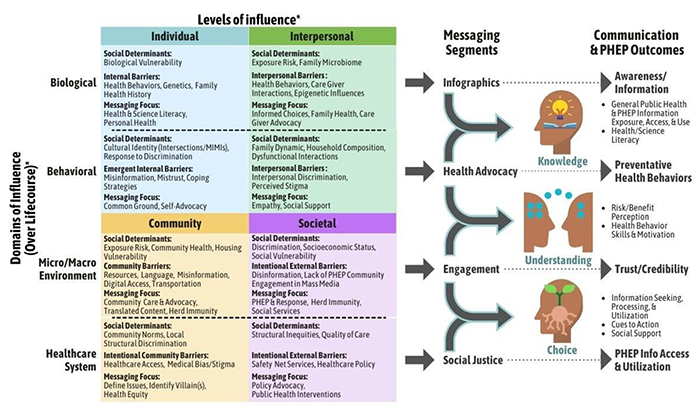
Figure 1. HMI Public Health Messaging Framework. This conceptual model—adapted from NIMHD [6]—reflects social, biological, and behavioral factors that inform the development of communications that promote health among BIPOC/MIMI. Delineated across levels of influence (Individual, Interpersonal, Community, Societal) and domains of influence (Biological, Behavioral, Micro/Macro Environment, Healthcare System) are relevant social determinants and barriers along with the messaging focus for each pairing to provide rationale for the associated messaging segments (Infographics, Health Advocacy, Engagement, Social Justice). The founding philosophy of HMI highlights the focus on pathways from perceptions to behavior to outcomes (Awareness/Information, Preventative Health Behaviors, Trust/Credibility, PHEP Info Access & Utilization) in promoting health literacy and self-advocacy as part of building behavioral skills and motivating health behavior change. This conceptualization is not intended to be exhaustive and may evolve over time.
Given the unmet needs of BIPOC/MIMI, HMI coalesced around a mission to develop innovative ways of using media and technology to improve communication of the benefits of vaccination. HMI began to create and disseminate live podcasts (https://tinyurl.com/HoodMed-Chats-YouTube) featuring health professionals and community activists to target these groups directly. HMI quickly expanded its programming over the course of the pandemic to include infographics and compelling public health messaging.
Currently, HMI develops culturally tailored public health messaging for BIPOC/MIMI. HMI forges authentic collaborations with grassroots stakeholders to influence public health behaviors and aid diverse communities in practical and actionable ways. These efforts are complemented by efforts to create, translate, and disseminate sustainable research-driven solutions for diverse BIPOC sub-segments. HMI seeks to integrate these efforts across health disciplines—including maternal and child health, preventive medicine, genetic counseling, and community education—to address widespread disparities in BIPOC/MIMI.
To further disseminate this tailored approach, HMI developed the HMI Framework (Figure 1)—geared towards scientists, practitioners, and policymakers—that describes the process of developing culturally-tailored public health messages. The HMI Framework—adapted from the National Institute on Minority Health and Health Disparities (NIMHD) [6] and grounded in social psychology, communication, and Human Centered Design—posits that creating effective public health messaging necessitates establishing a sustainable connection to BIPOC/MIMI, which requires addressing the underlying structural issues facing specific sub-segments. The HMI Framework guides the creation of public health messages for BIPOC/MIMI at the community and population levels, via the following sequential process:
1) Identify the target population and sub-segments: The cornerstone of HMI’s approach is a nuanced and strategic approach to reaching BIPOC/MIMI. This necessitates a messaging approach that conceptualizes marginalized communities as heterogeneous rather than monolithic.
2) Identify barriers and challenges: HMI identifies barriers and challenges for the overall target population as well as the target subsegment(s), prioritizing stakeholder and community outreach in order to accomplish this goal. This may include the deployment of a diverse range of participatory strategies—including stakeholder interviews, system mapping, and qualitative research—selected based on existing resources and project goals.
3) Determine target outcomes: Taking into account the population and sub-segment needs, experiences, and challenges, HMI devises messaging approaches to achieve Public Health Emergency Preparedness (PHEP) outcomes to facilitate the effectiveness of messaging on behavioral change [7]. HMI also deploys a range of strategies to maximize effectiveness across all steps.
1) Community connection: HMI engages with trusted messengers and community organizers at each step. HMI also signals allyship to the target communities and provides a platform to collaborate on messaging. This ensures that approaches are aligned with communities’ needs and promote activism within communities.
2) Data-driven approaches: HMI integrates data-driven and algorithmic approaches to complement community oriented efforts. This includes the use of natural processing research protocols to analyze digital chatter, understand messages that are most resonant with population sub-segments, and iteratively revise the messaging strategy.
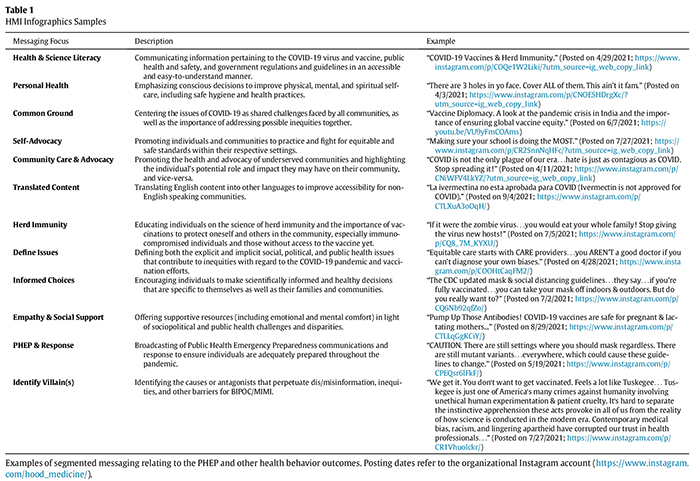
3) Wide-scale dissemination strategies: HMI utilizes multiple virtual and technological platforms, including podcasts, blogging, targeted social media engagement, satellite radio programming, webinars, and video Infographics (examples provided in Table 1).
In these efforts, partnerships with media platforms and civic organizations have promoted viewership, engagement, and increased access to relevant audiences.
4) Iterative message refinement: HMI messaging is continually refined via ongoing collaborations and dialogues with community members and leaders as well as epidemiological findings.
The pandemic was a stark reminder of the persistent structural disparities endured by BIPOC/MIMI. Targeted mal/dis/misinformation by various anti-vaccine organizations and other actors further inequities [8]. Ultimately, both non-governmental and governmental organizations (e.g., the Rockefeller Foundation) stepped in to try to address these inequities and the Biden Administration formed a Health Equity Task Force—comprised of senior leadership in health equity [9,10]—in August 2021 to address COVID-19 inequities. With this increased momentum, we must prioritize approaches that are both community-oriented and data-driven. Adapting and scaling the HMI model holds potential for combating health disparities for BIPOC/MIMI during and post-pandemic.
Declaration of Competing Interest
The authors have no declarations to make.
References
[1] Wrigley-Field E, Garcia S, Leider JP, Van Riper D. COVID-19 Mortality At The Neighborhood Level: Racial And Ethnic Inequalities Deepened In Minnesota In 2020: Study examines COVID-19 racial and ethnic inequalities in Minnesota communities. Health Aff (Millwood) 2021;40(10):1644–53.
[2] Norris K, Gonzalez C. COVID-19, health disparities and the US election. EClinicalMedicine 2020;28:100617.
[3] Rusoja EA, Thomas BA. The COVID-19 pandemic, Black mistrust, and a path forward. EClinicalMedicine 2021;35:100868.
[4] Samra R, Hankivsky O. Adopting an intersectionality framework to address power and equity in medicine. The Lancet 2021;397(10277):857–9.
[5] Rodriguez-Seijas C, Eaton NR, Pachankis JE. Prevalence of psychiatric disorders at the intersection of race and sexual orientation: Results from the National Epidemiologic Survey of Alcohol and Related Conditions-III. J Consult Clin Psychol 2019;87(4):321.
[6] National Minority Health and Health Disparities Research Framework. NIMHD. Accessed October 12, 2021. https://www.nimhd.nih.gov/researchFramework
[7] Revere D, Nelson K, Thiede H, Duchin J, Stergachis A, Baseman J. Public Health Emergency Preparedness and Response Communications with Health Care Providers: A Literature Review. BMC Public Health 2011;11(1):337.
[8] Covid’s devastation of Black community used as “marketing” in new anti-vaccine film. Accessed August 27, 2021. https://www.nbcnews.com/news/nbcblk/covids-devastation-black-community-used-marketing-new-anti vaxxer-n1260724
[9] Biden Picks Dr. Nunez-Smith to Lead Health Equity Task Force – The New York Times. Accessed August 27, 2021. https://www.nytimes.com/2021/01/08/health/ coronavirus-marcella-nunez-smith.html
[10] New Vaccine Equity Cooperative Launches to Advance Covid-19 Vaccine Access and Readiness. The Rockefeller Foundation. Accessed August 27, 2021. https:// www.rockefellerfoundation.org/news/new-vaccine-equity-cooperativelaunches-to-advance-covid-19-vaccine-access-and-readiness/
Corresponding author: Emily Hotez, Ph.D., David Geffen School of Medicine, University of California, Los Angeles (UCLA), 911 Broxton Ave, Los Angeles, CA, 90024, 301- 9225516
E-mail addresses: ehotez@mednet.ucla.edu (E. Hotez), charles.senteio@rutgers.edu(C. Senteio). y Dr. Hudson and Emily Hotez are co-first authors.
https://doi.org/10.1016/j.eclinm.2021.1011992589-5370/© 2021 The Author(s). Published by Elsevier Ltd. This is an open access article under the CC BY license (http://creativecommons.org/licenses/by/4.0/)